
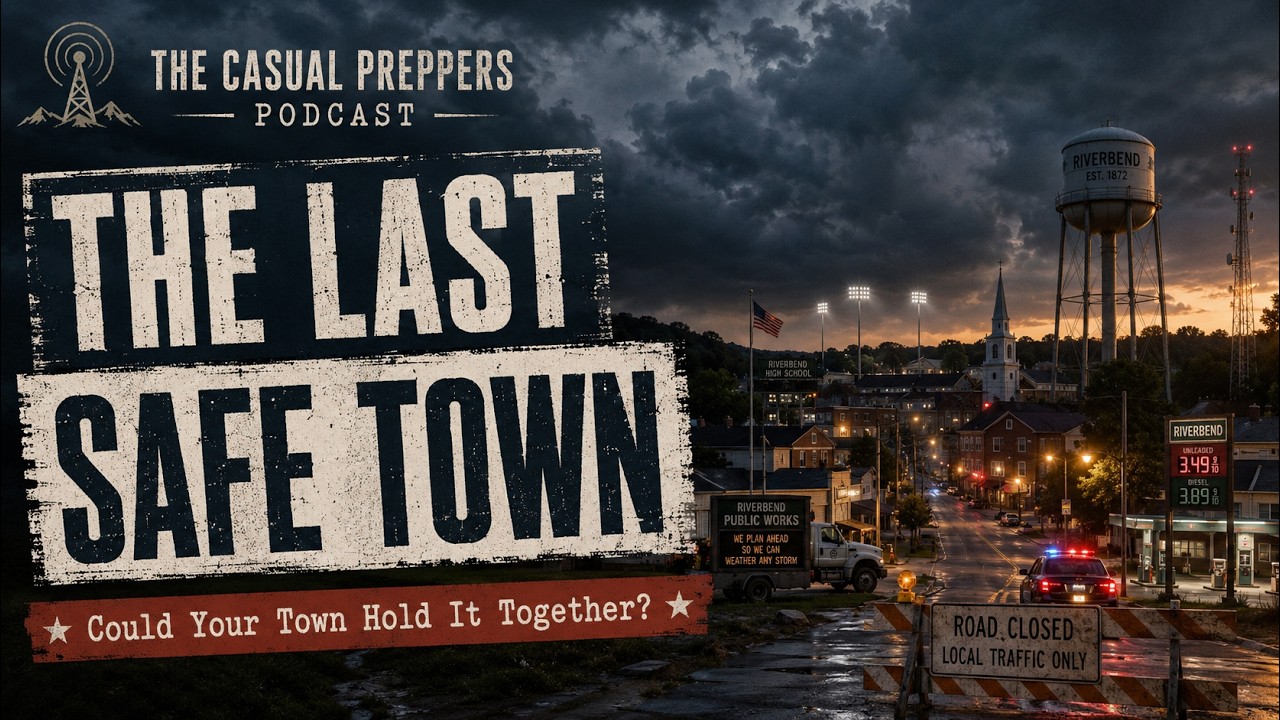
The Last Safe Town: Could Your Town Hold It Together?
When people think about emergency preparedness, they usually picture two choices: stay home or bug out. But there is a third piece that matters just as much, and most people barely think about it until something goes wrong.
Your town.
The actual place you live. The one with the schools, churches, grocery stores, gas stations, water tower, clinic, feed store, public works yard, county roads, cell towers, local radio station, and that one intersection everyone complains about. In a real emergency, all of those things become part of your survival picture whether you planned on it or not.
That is what this episode is about. Could your town hold together for 72 hours? What about three weeks? What about three months? A small town is not automatically safe just because it is small. And it is not automatically doomed because it has limits. The real question is whether the right pieces are there, whether they can keep working under pressure, and whether the people in town can coordinate before things get ugly.
What Could Cut Your Town Off?
Every town has a few events that could suddenly make it feel isolated or overwhelmed. For some places, it is winter storms, closed mountain passes, and power outages. For others, it is wildfire smoke, flooding, fuel shortages, chemical spills, cyberattacks, civil unrest, or a regional evacuation that pushes people into town looking for food, fuel, shelter, and medical help.
The important thing is to stop thinking only in generic disaster terms. Your town has probably already shown you its weak spots. The road that closes first. The low area that floods. The neighborhood that always loses power. The store that gets cleaned out before a storm. The bridge everyone depends on. The cell service that gets weird when the weather turns.
Those smaller problems are previews. If the same problem got bigger, lasted longer, or hit at the worst possible time, that might be the event that really tests your town.
Roads, Layout, and Movement
A town can have useful resources and still be fragile if everything is spread out badly. Maybe the hospital is on one side of town, the main fuel stop is out by the highway, the school shelter is across a bridge, and the grocery store sits next to the worst intersection in town.
On a normal day, that layout is just annoying. In an emergency, it can become a real problem.
A mile in a truck is nothing. A mile on foot with kids, medicine, groceries, snow, smoke, heat, or an injury feels very different. That is why transportation and layout matter so much. Can people get to the resources they need? Can supplies get where they need to go? Can emergency services still move if roads are blocked, fuel is limited, or the main route is shut down?
We also talk about overlooked transportation assets like school buses, senior vans, church vans, county transit, medical transport, and volunteer drivers. School buses especially are a huge town resource. They already have drivers, routes, radios, maintenance yards, fuel access, and the ability to move a lot of people at once.
Water, Sanitation, and the Boring Stuff That Keeps You Alive
Most people do not know where their town water actually comes from. Wells, springs, reservoirs, rivers, canals, water towers, treatment plants, pump houses, or water piped in from somewhere else all tell you something about how fragile or resilient your town might be.
And water is not just drinking. It is toilets, cooking, cleaning, medical care, firefighting, livestock, gardens, and basic hygiene. If the water stops, sanitation becomes a problem fast. Toilets stop working. Trash piles up. Wastewater can back up. Sickness and morale problems start creeping in.
This is where public works becomes one of the most important groups in town. They know the town underneath the town. Water lines, sewer lines, storm drains, snow routes, pumps, culverts, shutoffs, generators, barricades, and all the weird little problem spots nobody else thinks about.
Their yard might be one of the most valuable places in town during a crisis. Backhoes, loaders, dump trucks, plows, pumps, sandbags, pipe, spare parts, gravel, road salt, and fuel can decide whether a problem stays small or turns into a cascading mess.
What Exists After the Grocery Store?
Most people think of food in terms of grocery stores, Walmart, dollar stores, gas stations, restaurants, and food banks. That is the obvious layer. But the bigger question is what exists after the shelves start getting thin.
Does your town have farms, ranches, grain bins, dairies, meat processors, bakeries, produce stands, restaurant suppliers, food warehouses, gardens, hunting areas, or local producers? A town with food beyond the grocery store has more options, even if those options are imperfect.
Restaurants can be a bigger asset than people realize because they have food, freezers, commercial kitchens, and people who know how to cook at scale. Schools and churches may already have kitchens, volunteers, storage, serving areas, parking lots, and people who know how to organize meals for groups.
But food is not just a supply problem. It is a trust problem. If people think food is being hidden, stolen, wasted, saved for certain groups, or handed out unfairly, the town can start coming apart even while supplies still exist.
Fuel, Power, and Comms
Fuel is another area where most people only think about gas stations. But in a town, fuel may also be sitting at propane yards, farm tanks, ranch tanks, school bus garages, public works yards, construction companies, trucking yards, hospitals, telecom sites, and utility yards.
The catch is access. A gas station with no generator may just be a giant underground tank nobody can pump from. A building with a generator still needs fuel, maintenance, and someone who knows how to run it.
Payment systems matter too. If the power or internet goes down, do stores still take cash? Can they write paper receipts? Do they have a way to keep selling or distributing food and fuel without the normal card systems?
Communication ties all of this together. If phones and internet are unreliable, can the town still tell people where to get water, what roads are closed, where shelters are open, and when the next update is coming? Local radio, local TV, official radios, ham operators, repeaters, physical message boards, and trusted public voices can all matter.
People can usually handle bad news better than no information. Silence is where rumors take over.
Local Skills and Leadership
One of the best ways to understand a town is to ask what it actually does for work. Farming, ranching, oilfield, mining, construction, trucking, tourism, manufacturing, healthcare, college, government, retail, or mostly commuting somewhere else.
That work tells you what kind of resources are sitting around. Equipment, fuel, trucks, tools, commercial kitchens, repair shops, storage space, and skilled people. Mechanics, welders, electricians, linemen, plumbers, equipment operators, truck drivers, cooks, radio operators, nurses, ranchers, farmers, retired responders, and old-timers are all part of the real survival inventory.
A town that can fix, haul, cook, move, repair, build, clear, and improvise without waiting for outside help has a much better shot.
But resources only go so far without leadership. A town can have water, food, fuel, equipment, and good buildings and still fall apart if nobody knows who is actually making decisions. The mayor, sheriff, fire chief, emergency manager, public works director, school superintendent, county commissioner, hospital administrator, pastors, and respected business owners may all matter.
Official authority matters, but trusted authority matters too. In small towns, people often follow the person they believe is steady and competent before they follow the person with the title.
A town usually becomes a more intense version of what it already is. Helpful towns get more helpful. Divided towns get more divided. Capable towns start solving problems. Gossip-heavy towns turn into rumor machines.
The Green, Yellow, Red Test
In the episode, we use a simple way to look at your town: green, yellow, or red.
Green means that part of town is probably an asset. It has resources, people, access, backup options, and some ability to keep working under pressure.
Yellow means useful, but fragile. There is something there, but it depends on a few weak points like one building, one road, one generator, one small crew, or one person who knows how everything works.
Red means that part of town could break fast. One source, one bridge, one pump, one operator, no backup, no plan, no trust, or no clear communication.
The big categories to score honestly are water, sanitation, food, fuel, power, comms, medical, transportation, public works, security, leadership, and mindset. Those are the things that decide whether a town holds together or starts coming apart.
If your town has mostly green and yellow, it probably has a chance. It may still be messy, but there are things to work with. If it has several red areas in critical systems, it may look fine on a normal day but struggle hard once pressure hits.
Walk Your Town Like a Prepper
The point of this episode is not to make everyone paranoid about their town. It is to help you stop being blind to the place you already depend on.
Drive or walk through your town and look at it differently. Find the water towers, fuel yards, comms towers, bridges, chokepoints, clinics, shelters, schools, churches, pharmacies, grocery stores, public works yard, and vulnerable neighborhoods.
Then watch what happens during small disruptions. A winter storm, power outage, wildfire scare, county fair, football game, or panic-shopping rush can tell you a lot. Where does traffic back up? Which shelves empty first? Who communicates well? Who steps up? What roads become a problem?
Your town could become one of your greatest survival assets.
Or it could become the thing you have to survive.
Listen to the full episode of The Last Safe Town: Could Your Town Hold It Together? on The Casual Preppers Podcast.
Stay Survived.




The reminder to map your town’s real resources—especially the water tower, clinic, and public works yard—is practical and easy to overlook. I’ve been using https://emergentai.pro/emergent-for-students
The point about your town being the overlooked third option really lands—especially the water tower, clinic, and bottleneck intersection. I’ve been using https://codex-usage-dashboard.github.io/